Mouse & Rat Control at Home: How to Get Rid of Rodents Without Odours or Worry
Rodents cause damage, spread disease, and breed fast. Learn the signs they leave, why traps alone fall short, and how professional treatment seals every way in.
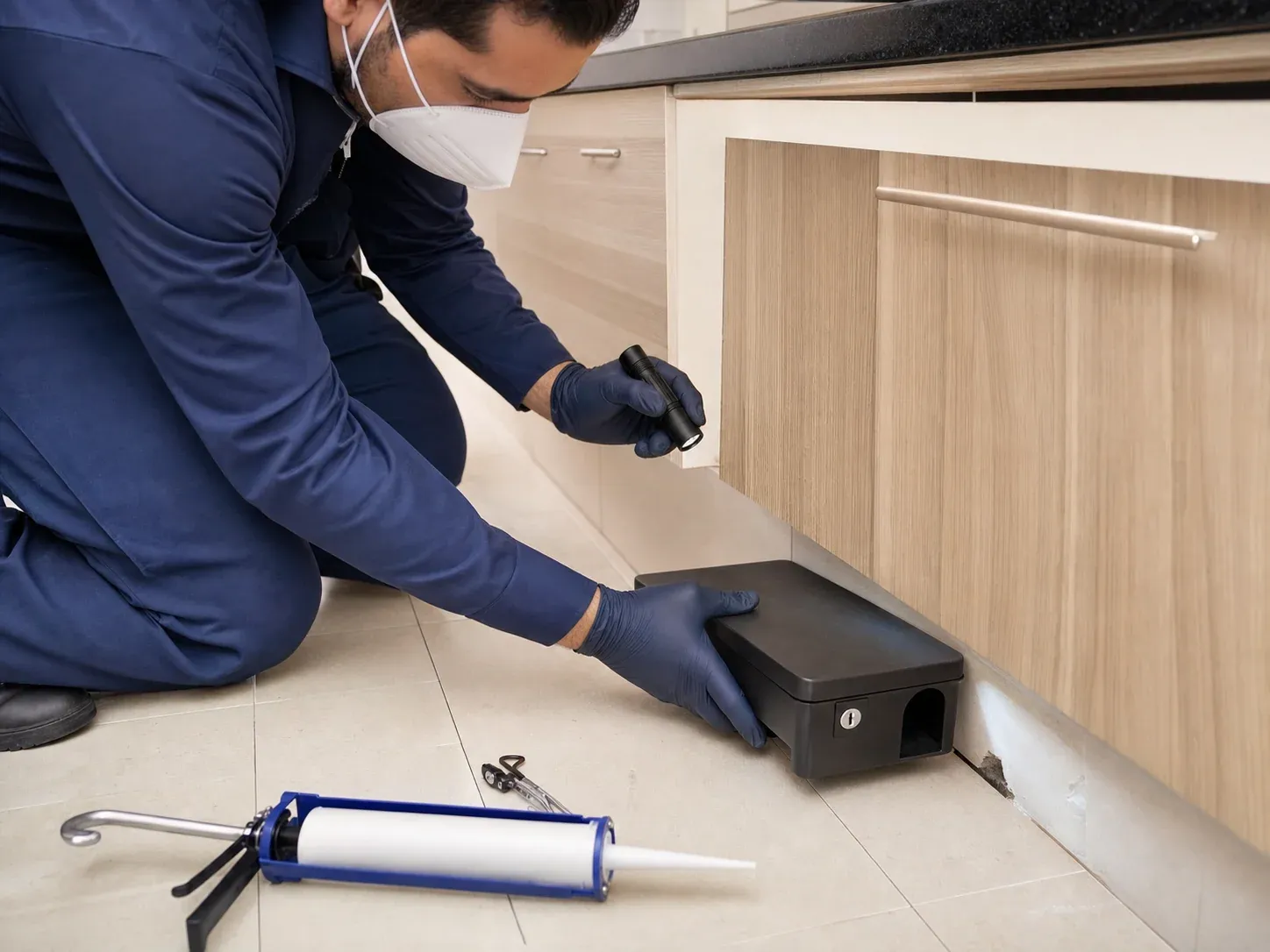
The first time you hear that scratching at night, you lie in bed trying to convince yourself you imagined it. A faint noise comes from behind the cupboard or above the false ceiling, stops the moment you move, then starts again as soon as you go quiet. The next morning you find the rice bag gnawed open at the bottom, or a row of teeth marks on the washing machine cable, or a small black speck next to the cooker that you can’t quite place. That’s the moment it sinks in: someone has been living in your home without you noticing.
Mice are not just a nighttime nuisance, and this isn’t a small thing you fix with a supermarket trap and forget about. A single rodent gnaws every day because its teeth never stop growing, so it chews through food, wood, and wiring not because it’s hungry but because it has to file its teeth down. At the same time it walks across kitchen counters and leaves behind urine and droppings that contaminate food and spread disease. Worse than all of that, it breeds fast, so what started as one or two mice can become an entire family within a few weeks if you leave it alone.
In this article we’ll go step by step: how to tell you actually have mice and aren’t imagining it, the difference between a mouse and a rat, where they get in and why, why poisons and traps on their own usually fail, and what a professional technician does to close the matter for good without filling your home with odours. Everything here is practical and concrete, drawn from the reality of an Egyptian home, so you walk away knowing exactly what to do.
The Difference Between a Mouse and a Rat, and the Rodent Types in Egyptian Homes
People say “mouse” about anything that runs along the wall, but there’s a difference that genuinely matters for how you control them. Most of the rodents that show up in Egyptian homes fall into two main types.
The Small House Mouse
This is the little one, around 7 or 8 centimetres long not counting the tail, grey or light brown, with a thin tail that’s long relative to its body. It likes to nest inside sofas and cupboards, behind appliances, and in the false ceiling. Its droppings are tiny, like a small black grain of rice, and it can get through a hole so small you’d never imagine it squeezing through. This is the one you’ll most often find inside flats and on the upper floors.
The Rat (the Big Mouse)
This is the larger size, with a full body that can weigh up to half a kilo, and it shows up more on ground floors, in basements, near drainpipes, and around gardens and garages. One type prefers low, damp places and sewers; another climbs and favours high spots and ceilings. Its droppings are bigger and thicker, and its gnawing is far more aggressive, to the point where it can chew through wood, thick plastic, and even heavy cables.
Why does this distinction matter? Because the size of the entry point you need to seal changes, the size of the bait station and trap changes, and where you place them changes too. You’ll find the small mouse in the kitchen and the cupboard; you’ll find the rat coming up from the yard below or from a drainpipe. The first thing a professional technician does on arrival is work out which one they’re dealing with, and they build the plan around that.
Here’s a simple rule: the mouse sneaks in, the rat breaks in. For the first, you need to seal the small holes; for the second, you need to secure the large openings and the drainpipe.
How Do I Know I Have Mice?
Rodents hide by nature and move at night, so it’s rare to see the mouse itself during the day. If you spot one strolling in front of you in daylight, that usually means the numbers have grown to the point where the hiding spots are no longer enough. That’s why we rely on the signs far more than on a direct sighting. These are the clearest pieces of evidence:
- Noises at night: scratching or the soft sound of running above the false ceiling or inside a hollow wall, and sometimes a steady gnawing sound. The noise stops when you move and returns when you go quiet.
- Droppings: small black grains shaped like a grain of rice or a little larger. You’ll find them gathered in specific spots: in a drawer, behind the cooker, under the sink, in the corner of a cupboard. The more of them piling up in one place, the more that spot is an active runway or nest.
- Gnaw marks: bags chewed open from the bottom, cardboard boxes torn open, the edges of wooden doors marked with teeth, and the most dangerous of all, appliance cables with gnaw marks on them.
- Grease marks on the walls: this is a sign people overlook, but it matters a great deal. A mouse walks the same path every day, right along the wall, and the natural oils in its coat leave a faint dark-grey line running along the wall or around the holes it passes through. Find that line and you’ve found the route.
- The smell: as numbers grow, a distinctive, sharp urine smell appears, close to ammonia, especially in closed-off spaces like a storeroom or under the sink.
- Your cat or dog reacting: if you have a pet and it keeps staring at a particular spot on the wall or sits for hours in front of a cupboard, pay attention. Its senses are picking up something yours aren’t.
You don’t need every single sign to be present. Two or three are enough to confirm there’s real activity and that you need to act quickly, because every week of delay means more of them and more routes through your home.
Where Do Mice Get Into the Home, and Why?
To solve the problem at its root, you have to understand what a rodent is looking for the moment it gets near your home. A mouse comes in when it finds three things available: easy food, water, and a warm, safe place to hide and breed. A home that offers all three becomes a target, especially in winter when it’s cold outside and warm indoors.
Food
Crumbs under the dining table, scraps in the rubbish bin, pet food left on the floor all night, open bags in the cupboard, even birdseed or cat food out on the balcony. A rodent has a strong sense of smell and can detect a food source from a distance.
Water
A small leak under the sink, a drip from a pipe, damp in the bathroom, even the washing-up water you leave sitting overnight. A rodent can tolerate a shortage of food but it needs water, so any water source becomes a draw.
Entry Points
And this is the heart of the matter. The small mouse gets through a hole less than two centimetres across, meaning any opening you could fit a pencil into, a mouse can squeeze its body through. The most common entry points in an Egyptian home:
- The gap around water and drainage pipes coming in under the sink or behind the water heater.
- Under exterior doors that have a clearance off the floor.
- Vents for air conditioning, fans, and extractors that have no mesh on them.
- Cracks in the exterior walls or around old windows.
- The openings for electricity and gas meters.
- Kitchen and bathroom floor drains without a tight cover (this is the main gateway for rats coming up from the sewers).
The idea you need to grasp: as long as the door is open, every rodent you remove will be replaced by another. That’s why the most important part of any serious plan isn’t trapping but sealing the entry points, and we’ll go into that in detail later.
Why Are Mice a Real Danger and Not Just a Nuisance?
Sometimes people put off dealing with mice because they see it as nothing more than a matter of disgust. The truth is that the danger goes much further than that, and on more than one front at the same time.
The Health Front
Rodents carry a range of diseases, either directly through the urine and droppings that contaminate food and surfaces, or indirectly through the parasites that live on them, like fleas and ticks. A mouse walks through rubbish and sewers and then walks across your kitchen counters and over the food you eat, carrying contamination from the filthiest place to the cleanest place in your home. On top of that, when its dried droppings break up into the air, people with allergies or asthma are affected by them.
The Material Front
A rodent’s teeth grow constantly, so it’s forced to gnaw nonstop to file them down. The result is that it ruins furniture, doors, bags, food, books, and clothes. But the most dangerous thing it does is chew through electrical wiring. A gnawed, exposed wire next to wood or a curtain can throw a spark and start a fire, and the statistics on house fires place rodents among the recurring causes of short circuits with no obvious explanation. If you notice a faint burning smell or find that the power keeps cutting out on an appliance for no clear reason, check the wiring behind your appliances.
The Spread Front
This is the one that turns the whole thing into a race against time. A single female mouse can produce several litters a year, each litter holding a good number of young, and those young reach breeding age in about two months. Do the maths and you’ll understand why one or two mice in the kitchen became a full colony in the garage two months later. Every day you delay, you’re not just putting off the solution, you’re enlarging the problem you’ll have to deal with.
That’s why acting quickly and correctly saves you far greater harm over the long run, both to your health and your wallet.
Why Don’t DIY Traps and Poisons Solve the Problem on Their Own?
This is the question that most needs a straight answer, because most people start with these solutions and after a while discover the problem has come back or never went away in the first place. Traps and bait are good tools, but on their own they treat the symptom rather than the cause, and for practical reasons.
Problem One: the Entry Routes Are Still Wide Open
This is the core of it. If you trap five mice but leave the hole they’re coming through, more will follow. You’re emptying the home of what’s inside, but the gate is still working. That’s why so many people end up trapping week after week and feel the problem is never-ending, and the reason is that they’re removing individuals without closing the door.
Problem Two: the Mouse Learns
A rodent is a clever, wary animal, cautious of anything new in its environment. If you set a trap out in the open in the middle of the room, the mouse will avoid it and go around it. And if you touch the bait or the trap with your bare hand, your scent lingers on it and the mouse smells it and stays away. The difference between a professional technician and just anyone setting a trap is that the technician knows exactly where to place it on the active runway, how to make it a natural part of the surroundings, and how not to handle it in a way that spooks the rodent.
Problem Three: Poisons Are Dangerous to Children and Pets
The poison you buy from the market, you place in your home, and that home has kids playing on the floor and maybe a cat or a dog. If poisoned bait reaches a child’s hand or a pet’s mouth, it’s a disaster. More dangerous still, if a pet eats a poisoned mouse, it can be affected by the poison too, indirectly. That’s why scattering poison randomly and out in the open in the home is a reckless move, and a professional uses lockable bait stations that only the technician can open with a key.
Problem Four: the Smell of a Dead Rodent
And here’s the nightmare that genuinely frightens people. If a mouse eats poison and goes off to die inside a wall, under the false ceiling, or behind a cupboard, the carcass rots and gives off a horrendous smell that lingers throughout the home for a week or more, and there’s no easy way to reach the body to remove it. This is exactly what we work to avoid in professional treatment, and we’ll explain how shortly.
So the bottom line: traps and bait are part of the solution, not the whole solution. Without sealing the entry points, reducing what draws them in, and a carefully thought-out placement plan, you’re just going in circles.
Natural and Repellent Methods People Ask About: Do They Actually Work?
Every time this topic comes up, one question keeps coming back: “I heard peppermint repels mice,” or “I put chilli and pepper by the hole.” Let’s talk honestly, without overstating it in either direction.
Peppermint oil does have a sharp smell that rodents dislike, and the same goes for hot pepper, cloves, and certain essential oils. You might find a mouse avoiding a spot where you’ve placed a cotton ball soaked in peppermint oil for a short while. But the problem comes down to three points you need to be clear about:
- The effect is very temporary. The smell evaporates within a day or two, so you’d have to keep refreshing it constantly, and in practice nobody keeps replacing peppermint cotton in every corner around the clock.
- Hunger beats the smell. If there’s a source of food and water behind that smell, the rodent will put up with it and pass right through, because the food matters more than the comfort of its nose. A repellent delays; it doesn’t prevent.
- It doesn’t solve the problem of what’s already inside. If a nest has already formed inside the home, the smell won’t drive them out; at best it might delay new ones coming in.
So the fair verdict: these natural methods can be a minor preventive aid at a specific spot, but don’t rely on them as a solution for an existing infestation. If you have real activity, a natural repellent won’t close it down. File them under “does no harm,” not under “solves the problem.”
The same applies to the devices that emit ultrasonic waves and are marketed as repelling mice: the practical evidence for them is weak and contradictory, and rodents adapt to the sound after a while. Don’t build your plan on them.
How Does Professional Control Actually Work?
Now that we understand why isolated solutions fail, let’s look at what a professional technician actually does when they come into your home. The whole idea is that it’s an integrated plan, not a single move, and each step builds on the one before it.
First: Inspection and Reading the Home
The technician walks through the home as if reading a book. They look for droppings and grease marks on the walls to pin down the active runways, they check the likely entry points behind appliances, under sinks, and around pipes, and they determine whether you’re dealing with a small mouse or a big rat, and whether the infestation is small or well established. This reading is what shapes everything that follows, which is why a serious inspection is what sets things apart from any haphazard fix.
Second: Identifying and Sealing the Entry Points
This is the backbone of the plan. The technician seals the burrows and gaps with materials rodents can’t gnaw through, like steel wool packed into the opening, a special filler, or metal mesh over air conditioning vents and extractors. They make sure the gap around the pipes is closed, that the floor drains have tight covers, and that the clearance under exterior doors is dealt with. The goal is to shut the gates the rodents come through.
Third: Tamper-Proof Bait Stations Kept Away From Children
Instead of dangerous exposed poison, the technician uses lockable bait stations, so that only the rodent can get inside and feed, while a child’s hand or a pet’s mouth can’t reach the bait at all. These stations are placed in carefully chosen spots along the runways, against the walls and in the dark corners rodents favour, not out in the middle. And even so, in places with children or pets, the technician weighs things up and may rely more on mechanical traps to reduce any risk.
Fourth: Traps on the Active Runways
Mechanical traps are placed along the same runways identified from the grease marks and droppings, facing the right way and flush against the wall (a rodent walks along the wall, not down the middle). These give a fast result in cutting the numbers, and their big advantage is that they catch the rodent in a visible spot you can remove, which reduces the chance of a hidden death inside the walls.
Fifth: A Plan to Prevent Their Return, With Follow-Up
Once the numbers drop and you’ve confirmed the activity has stopped, the part that makes the result last comes in: making sure every entry point has been sealed, prevention advice for the home, and a follow-up visit to confirm no activity has returned. This is the difference between “they disappeared for a week and came back” and “we finished the job.”
The rule we work by: we don’t chase mice, we close the home off to them and make it a place that isn’t fit for them to live in. Once the home is sealed and there’s no easy food, the rodent leaves it of its own accord.
Why Is “Sealing the Entry Points” More Important Than Trapping?
If you take just one idea away from this article, make it this one. Trapping deals with the result; sealing the entry points deals with the cause.
Picture a tap left running with water flooding the floor, while you sit there scooping the water out with a cup. You could keep scooping all day and wear yourself out, but as long as the tap is open, the water won’t stop. Trapping on its own is the cup; sealing the entry points is turning off the tap first.
A rodent breeds outside too, in the building, at the neighbours’, in the yard, and on the street. As long as you have an open hole, you’re not dealing with a fixed number, you’re dealing with a continuous stream of rodents coming in. Seal the hole and you stop the stream, and then trapping finishes off whatever got shut inside, quickly and efficiently, with nothing coming to replace it.
This is also the reason a reputable company offers a guarantee on its work, because it doesn’t just trap, it closes off the access points, so it’s confident the problem won’t easily return. Anyone who only traps can’t guarantee anything, because the door is still open.
How Do We Work Without Leaving Odours in the Home?
This is a point that genuinely keeps people up at night, and it deserves a proper explanation. The well-known nightmare is a mouse eating poison and going off to die in a hidden spot, leaving the smell lingering in the home for days. How do we avoid that?
- Relying on traps in sensitive areas: inside the flat, in the kitchen and the bedrooms, we prefer mechanical traps that catch the rodent in a visible spot we can remove right away, so no carcass disappears into a wall.
- Placing bait in exterior and perimeter areas: bait stations go more in the areas surrounding the home, like the yard, the garage, the roof, and the mouths of external openings, so that if a death does occur it’s outside the living space.
- Follow-up and removing any dead rodent quickly: follow-up visits include checking the stations and removing any dead rodent quickly before a smell can develop.
- Skill in reading the runways: the more precise the trap placement is on the active runway, the faster the rodent is caught and in a clearer spot, and the lower the chance it goes off to die somewhere out of reach.
The result is that the home stays clean without that revolting smell, and that’s a big difference between considered work and a haphazard job that dumps poison and walks away.
What Do Mouse Control Prices Depend On?
A natural question, and the first thing anyone thinks about. The honest answer is that there’s no fixed figure that can be quoted before an inspection, because the price is built on real factors that vary from home to home:
- The size of the infestation: one or two mice that just got in is not the same as a well-established colony in an old building. The more the numbers and the spread, the more effort and the more visits.
- The area and type of building: a small flat is not the same as a villa with a garden, which is not the same as a shop or a restaurant, which is not the same as a warehouse or a factory. A larger area with more access points needs more stations and traps.
- The number of entry points that need sealing: a well-sealed home with one or two holes is not the same as an old home with many access points that needs broader sealing work.
- How much follow-up is needed: a large infestation needs more follow-up until the activity stops completely.
- The presence of special circumstances: like a restaurant that has to maintain health requirements, or a home with children and pets that needs extra precautions.
That’s why the right approach is to request an inspection, have the technician see the situation on the ground, and give you a clear, written price before any work begins. Anyone who gives you a final figure over the phone without seeing the home is either guessing and may turn out more expensive, or lowballing to win you over and then bumping it up later. Transparency means you know the price after the inspection and before the work.
How Do You Choose a Good Rodent Control Company?
The market has plenty of people, and they don’t all work to the same standard. These are the signs to look for so you can be confident you’re dealing with a professional outfit:
- They inspect before they price: a serious company looks first and then tells you the price, not the other way around.
- They give a guarantee: a guarantee means the company is confident in its work and ready to come back if activity returns within the guarantee period. That makes a huge difference.
- They care about safety: they ask whether you have children or pets, they use lockable bait stations rather than exposed poison, and they explain the precautions to you.
- They’re transparent about the method: they tell you exactly what they’ll do, how they’ll seal the entry points, where they’ll place the traps, and what the follow-up plan is. Anyone who’s cagey and just tells you “we know our job” is a red flag.
- They have real experience with rodents: rodents have their own behaviour, and experience in reading the runways and identifying the rodent type makes a difference to the outcome.
- They provide follow-up: rodent control isn’t a single visit and done in most cases; follow-up is part of the plan’s success.
Ask these questions openly before you sign. A reputable company will be glad you’re asking and will answer clearly, because this is its work and it knows it well.
Prevention Tips That Keep Mice From Coming Back
Once the problem is treated, keeping the result is a shared responsibility. These are simple habits that make your home unappealing to rodents in the first place:
- Seal any new opening: check around the pipes, under the doors, and at the air conditioning vents from time to time, and close any new hole quickly before it becomes a gateway.
- Store food in airtight containers: rice, flour, pasta, and pet food, all in sealed containers, not open bags in the cupboard.
- Don’t leave food out overnight: especially cat and dog food, take it off the floor before you go to sleep.
- Empty the rubbish regularly and keep it covered: an open bin overnight is an open invitation. Use a bin with a lid and get rid of the rubbish as it accumulates.
- Fix any water leak: a rodent needs water, so cutting off its source makes your home less appealing.
- Tidy the storeroom and cut down the clutter: piled-up clutter provides perfect hiding spots. The less the pile-up, the fewer the nesting places.
- Clean behind appliances from time to time: the crumbs that gather behind the cooker and the fridge are among the most hidden sources of attraction.
These habits don’t take much effort, but they make the difference in staying confident that your home is sealed.
Frequently Asked Questions About Mice and Rodents
How small a hole do mice get through?
The small mouse can squeeze its body through an opening less than two centimetres across, meaning any hole you could fit a pencil into counts as a potential entrance. That’s why sealing the small openings matters just as much as sealing the big ones. A rat needs a larger opening, but its powerful gnawing lets it widen a small hole if it finds one.
How long does it take to get rid of them for good?
It depends on the size of the infestation. A small, new infestation can be sorted quickly in a visit or two with follow-up. A well-established infestation, or one in a building with many access points, needs more time and more visits to seal all the entry points and confirm the activity has stopped. The inspection is what gives you a realistic timeline.
Is the poison I buy from the market safe around my kids?
Exposed poison scattered randomly around the home is a real danger to children and pets, and there’s also the problem of the smell from a hidden death. The safer route is to use lockable bait stations or to rely on traps in places with children, and that’s what a professional technician does instead of taking the risk yourself.
I did everything and they still came back, why?
In 99% of cases the reason is the same: there’s an entry point still open. You’re removing what’s inside but the door is left open, so new ones come in. The fix is to focus on finding and sealing every access point, not just trapping. This is exactly what makes professional work with a guarantee stand out, because it closes the gates.
Do peppermint and chilli really repel mice?
Rodents dislike their sharp smell and it can delay them entering a particular spot for a short while, but the effect is temporary and evaporates quickly, and if there’s food behind the smell the rodent will put up with it and pass through. Treat it as a minor aid, not a solution for an existing infestation. If you have real activity, you need a serious plan.
I have a cat, is that enough?
A cat might catch a mouse or two and scare some off with its scent, but it’s not a solution for a real infestation. Rodents breed faster than a cat can hunt, and many of them nest in places the cat can’t reach, like the false ceiling and inside the walls. Keep it as a nice helper, but rely on a proper control plan.
Conclusion
Mice are not a problem you solve with a single trap or a bag of poison. This is a clever rodent that breeds fast and gets in through holes you haven’t noticed, and every day of delay adds to the numbers and the damage. A successful solution rests on a simple idea: close the home off to them. Identify the entry points and seal them, cut down the food and water that draw them in, place the bait and traps in the right spots in a way that’s safe for the family, and follow up until you’re sure it’s over. And all of that without filling your home with exposed poisons or the smell of dead rodents.
If you notice scratching at night, droppings in the kitchen, or gnaw marks on your wiring, don’t wait until the numbers grow. Acting early saves you damage, money, and effort. You can learn the details of our approach to rodent control, or browse all our pest control services if you need full protection for your home. And if you’re dealing with more than one type, read our article on getting rid of cockroaches as well.