How to Get Rid of Bed Bugs for Good: The Complete Step-by-Step Guide
How to tell if you have bed bugs, the methods that wipe them out at the root, and why DIY fixes usually fail. A practical guide from pest control experts.
You wake at three in the morning feeling an itch on your leg or your arm. You switch on the light and find a row of tiny red marks lined up in a single file, and you keep searching the bed without finding anything obvious. The next day you wake up drained, your eyes puffy from lost sleep, your mind stuck all day on the thought that something is biting you in the very bed where you are supposed to rest. This is not your imagination and it is not an allergy. It is almost certainly bed bugs, one of the insects most capable of turning a home upside down before anyone notices what is happening.
What makes a bed bug problem hard on you mentally, long before it becomes hard practically, is that it robs you of the one thing that gives you peace: your sleep. A person can put up with any insect in the kitchen or out on the balcony, but once the problem is in the mattress itself, you start to feel that nowhere in your home is safe. The anxiety grows because bed bugs hide so skillfully that you can spend weeks certain there is a problem without ever seeing the insect with your own eyes. That makes you doubt yourself and put off acting until the infestation grows and spreads into other rooms.
In this article we will talk plainly and in detail about bed bugs from start to finish: what they look like and how they live, how to catch them early, where they came from in the first place, why they are so hard to deal with that most home remedies fail against them, and the correct professional approach that actually ends the problem. My goal is for you to leave this article understanding your enemy well and ready to make the right decision that gives you and your home some rest.
What Are Bed Bugs and How Do They Live?
A bed bug is a small reddish-brown insect, similar to a lentil or an apple seed in size and flatness. An adult runs about 4 to 5 millimeters long, so you can see it with the naked eye if you look carefully. It has no wings, so it does not fly, and it does not jump the way a flea does. It moves by crawling, which keeps its spread slow at first and close to its food source, meaning the bed.
Its body is noticeably flattened from top to bottom, and that design is no accident. A flat body lets it slip into the tightest cracks and gaps: the stitching seam of a mattress, the gap between two pieces of wood in the bed frame, or behind wallpaper that has started to peel. This is why cleaning the visible surface rarely makes much difference. The insect lives in the hiding spots, not out in the open.
The Bed Bug Life Cycle
To understand why bed bugs come back after you think you have wiped them out, you need to understand their life cycle, which runs through three stages:
- The egg: A single female lays on average 5 to 7 eggs a week and can reach hundreds of eggs over her lifetime. The eggs are clear white, smaller than a pinhead, and stuck into cracks with an adhesive substance, which is why ordinary vacuuming struggles to remove them. More importantly, the eggshell shields what is inside from many surface insecticides.
- The nymphs (immature stages): Once an egg hatches, out comes a small nymph that resembles the adult but is smaller and lighter in color. A nymph passes through five growth stages, and each one needs a blood meal to grow and molt to the next. So the nymphs themselves bite and feed on your blood exactly like the adults.
- The adult: The fully grown insect capable of reproducing. An adult can live from 6 months to a year under normal conditions, and what makes it more dangerous is that it can survive without food for many weeks, sometimes months, when conditions suit it. This is why the idea of “shut the room and let them starve” almost never works.
Why Do They Bite at Night Specifically?
The bed bug is a nocturnal insect by nature. It hides all day and comes out to feed when you are asleep, still, and warm. The insect is drawn to three things you give off while you sleep: your body heat, the carbon dioxide you exhale with each breath, and certain natural skin odors. When it senses your body warmth it moves in, pierces the skin with a thin proboscis, and secretes a substance that numbs the spot slightly and stops the blood from clotting. That is why you usually do not feel the bite as it happens and only wake up to find its mark.
A meal takes the bug 5 to 10 minutes, after which it returns to its safe hiding place to digest. That is what lets you sleep next to it without feeling a thing, and it is what makes the discovery late in most homes.
How Do I Know if I Have Bed Bugs?
The biggest mistake people make is waiting until they see the insect itself. Bed bugs hide well, so the smarter move is to learn to read the signs they leave behind. These are the clearest clues, and if you find them you need to act quickly:
The Bites and What They Look Like
A bed bug bite has a distinct character that sets it apart from a mosquito bite. The key sign is that it comes in a row or a straight line, or in a cluster grouped close together, three or four bites in a sequence, because the insect bites several times as it travels across the skin. The bite shows up as a swollen red spot, sometimes with a darker point in the center, and it itches intensely. It usually appears on the parts left exposed while you sleep: the arms, neck, shoulder, back, and legs.
An important note: not everyone shows bite marks with the same intensity. Some people have very sensitive skin and develop large welts, while others may show no mark at all despite being bitten. So if one person in the house complains of bites and the rest do not, that does not mean there are no bed bugs.
Blood Spots and Droppings on the Bedding
These are among the clearest and most confirming pieces of evidence. If you find:
- Small blood spots that are brown or light red on the sheet or on the pillowcase, especially in the morning, that is usually the trace of an insect crushed while it was full and you turned over in your sleep.
- Small black dots as if someone flicked a pen, along the mattress stitching, in the corners of the bed, or on the wall beside it. These are bed bug droppings, which are digested blood, and if you press a damp cotton ball on them they will smear a reddish-brown mark.
These spots gather where the insects congregate, so if you find them concentrated in one particular corner, that points you to the main nest.
The Shells and the Eggs
Remember that nymphs molt five times. Each molt leaves behind a clear shell in a light honey color, shaped like an empty husk of the insect. When you find these shells gathered in cracks, that is solid proof of an active, breeding infestation, not just a single insect that wandered in by chance. Alongside them you may find the small white eggs glued into the stitching seams.
The Smell
In heavy infestations, bed bugs secrete a substance with a distinctive smell. People describe it as a heavy sweet odor, or something like spoiled almonds, or like a damp cloth left out too long. If you walk into a room and notice a strange smell with no obvious source, pay attention.
Where Exactly Should You Look?
To inspect on your own, focus on these spots in order, because they are the favorite hiding places:
- The mattress stitching seams on every side, especially the corners and the folded edges. Lift the mattress and look underneath.
- The clips that hold the mattress padding (the box spring) and the wooden base beneath it.
- The wooden bed frame, every joint and every screw hole, and especially the panel at the head of the bed (the headboard).
- The nightstand beside the bed, inside the drawer and behind it.
- The edges of carpet and rugs that meet the wall, and under the edges of wallpaper if it is peeling.
- The corners and cracks in the wall close to the bed, and behind picture frames and light switches.
The practical rule: start your search from the bed and spread outward in a circle. The farther you get from the bed, the lower the chance of finding bed bugs, because they want to stay close to their food.
Where Did the Bed Bugs in My Home Come From?
This question worries a lot of people, and there is one thing you should be at ease about from the start: bed bugs have nothing to do with cleanliness. The cleanest home can get infested, and that is no fault of yours or your housekeeping. Bed bugs hunt for blood, not dirt, so five-star homes and reputable hotels get infested like anywhere else. What matters is understanding how they get in so you can close those doors.
Travel and Hotel Stays
This is the first and most common cause. When you travel and sleep in a hotel or a furnished apartment that has bed bugs, the insect slips into your suitcase, into your clothes, or even into the jacket you draped over a chair. You carry it home without knowing. So one of the most important prevention habits is this: the moment you enter a hotel room, do not put your suitcase on the bed right away. Set it on the metal luggage rack or in the bathroom, and quickly inspect the mattress stitching before you settle in.
Used Furniture and Appliances
Buying a used bed, sofa, or mattress without a careful inspection is a big gamble. A used sofa in particular is a perfect hotspot, since it has plenty of gaps, stitching, and fabric. Used appliances can carry them too, even electrical units that sat stored in an infested space. If you are bringing in any used piece, inspect it very carefully in good light before it comes into the home.
Neighbors and Shared Buildings
In apartment blocks and adjoining units, bed bugs can move from one apartment to another through cracks in the walls, a pipe, or even under the apartment door. If a neighboring unit has an infestation and is being treated, the bugs may flee toward your apartment. For this reason, in buildings we sometimes recommend preventive treatment for the neighboring units, or at the very least inspecting them.
Moving and Relocating Furniture
When furniture is moved from one home to another, if the old furniture had an unnoticed infestation, it travels with you to the new home with complete ease, and suddenly you find yourself starting over in a place you thought was clean. If you are moving from a place where there is any suspicion, it is best to treat the furniture before it is set up in the new home.
Why Are Bed Bugs So Hard to Deal With?
Ask anyone who has worked in pest control and they will tell you that bed bugs are among the three hardest insects to deal with, full stop. The difficulty is not that the insect is strong, but that it combines several traits that make eliminating it require experience and method, not just a can of spray.
Deep Hiding
As we said, the flat body lets it get into places you simply cannot see. Any surface spray kills only what is out in the open and leaves the majority untouched in the cracks. A few days later they come back out as if nothing happened.
The Egg Problem
This is the single biggest challenge. Most insecticides affect the living insect, but the eggshell protects the embryo inside. So a strong spray might kill every adult and nymph present today, yet a week later the eggs hatch and a new cycle begins as if you never started. This is why serious treatment has to be repeated, or you use a method that kills the eggs themselves, such as heat steam.
Resistance to Insecticides
In many areas, bed bugs have developed resistance to certain common insecticides because of the random, repeated use of the same type over years. So someone can go buy the very spray that “everyone uses” and find it does almost nothing, because the bed bugs in their area have adapted to it. A professional company knows this and varies its materials and their mode of action.
Long Patience Without Food
A bed bug’s ability to hold out for months without a blood meal makes the “starve them out” trick a failure. It waits until you believe you are done and go back to sleeping in peace, then it shows up again.
Why Do Home Remedies Usually Fail?
I am not saying everything you do yourself is pointless, but it is important to be honest: there is a big difference between “easing the problem a little” and “ending it at the root.” Home remedies fail to end the problem for clear reasons:
- They treat the symptoms, not the source. People spray the spot where they were bitten or the surface where they saw an insect, while the real nest stays hidden somewhere else.
- No reach into the cracks. Ordinary spray does not penetrate deep into cracks, behind wood, and inside the mattress in any sufficient way.
- They do not treat the eggs. So you stay stuck in an endless loop of killing and hatching.
- Wrong dose and placement. A residual insecticide has to be applied at the right concentration in specific spots so it stays effective for weeks, and that takes knowledge of the insect’s behavior.
- Internet mixtures. Concoctions like salt, baking soda, or essential oils get spread around as if they were magic. The reality is that their effect on bed bugs is very weak or nonexistent, and they waste precious time while the infestation grows.
What happens in most homes is that a person spends two or three months trying one thing after another, the problem spreads from room to room, and in the end they turn to a company after the infestation has grown and now needs a bigger effort. Had they handled it correctly from the start, they would have saved time, blood, and nerves.
Home Methods That Can Help Temporarily
To be fair, there are home steps with real value, especially as supporting measures before or alongside professional treatment, or to reduce the infestation until the technician arrives. Do them knowing they ease the problem rather than end it:
- High-heat laundering: Bed bugs and their eggs die from heat. Wash everything washable (sheets, covers, pillows, curtains, even clothing that was near the bed) at the highest temperature the fabric allows, and ideally follow with high-heat drying as well. This wipes out whatever is in the fabric.
- Steam without washing: For items that cannot go in the washing machine, like the mattress itself or the sofa, a home steamer can help if it produces genuine hot steam that reaches the stitching seam. Just keep in mind that home steamers are far weaker than professional steam.
- Strong vacuuming: Run a vacuum with a narrow nozzle along the cracks, the stitching seams, and the carpet edges. This removes a portion of the insects and the exposed eggs. This part is critical: right after vacuuming, take out the bag immediately, seal it in a tight plastic bag, and throw it outside the home so nothing crawls back out.
- Encasement mattress covers: There are special zippered covers for the mattress and pillow that fully wrap them and trap any bed bugs inside from getting out and feeding, so they die over time, while also stopping new bugs from getting in. This is an excellent tool as part of a plan, and it makes it easier afterward to spot any insect on the smooth surface.
- Reducing hiding spots: Cut down the clutter around the bed. The fewer places it has to hide, the easier you make it to reach and eliminate it.
These steps make a tangible difference in easing the bites and reducing the numbers, but without professional treatment of the cracks and the eggs, there is a high chance the problem returns. Treat them as half the road, not the whole road.
How Is Professional Treatment Carried Out, Step by Step?
Proper professional treatment is not just “a guy who sprays.” It is an organized process that addresses every life stage of the insect and every place it hides. At Al-Almania Al-Mu’tamada for Pest Control we work with a clear method, so let me walk you through its steps so you know how to judge any company you deal with.
1. Inspection and Diagnosis
The technician comes first and performs a careful inspection. He identifies exactly where the congregation spots are, the size of the infestation (minor or widespread), which rooms it has reached, and the likely source. This inspection sets the whole plan, so any company that skips the inspection and quotes a fixed price over the phone without seeing the place is one to be wary of.
2. Preparation Before Treatment
Before treatment we ask you for a few simple preparations that raise the success rate: laundering the bedding, clearing the clutter around the bed, moving food and dishes away, and sometimes dismantling a few pieces of furniture to reach the cracks. The better the preparation, the deeper we reach the bed bugs.
3. The Dual Treatment: Spray Plus Heat Steam
This is the heart of the matter. We do not rely on a single method, because each method covers a part:
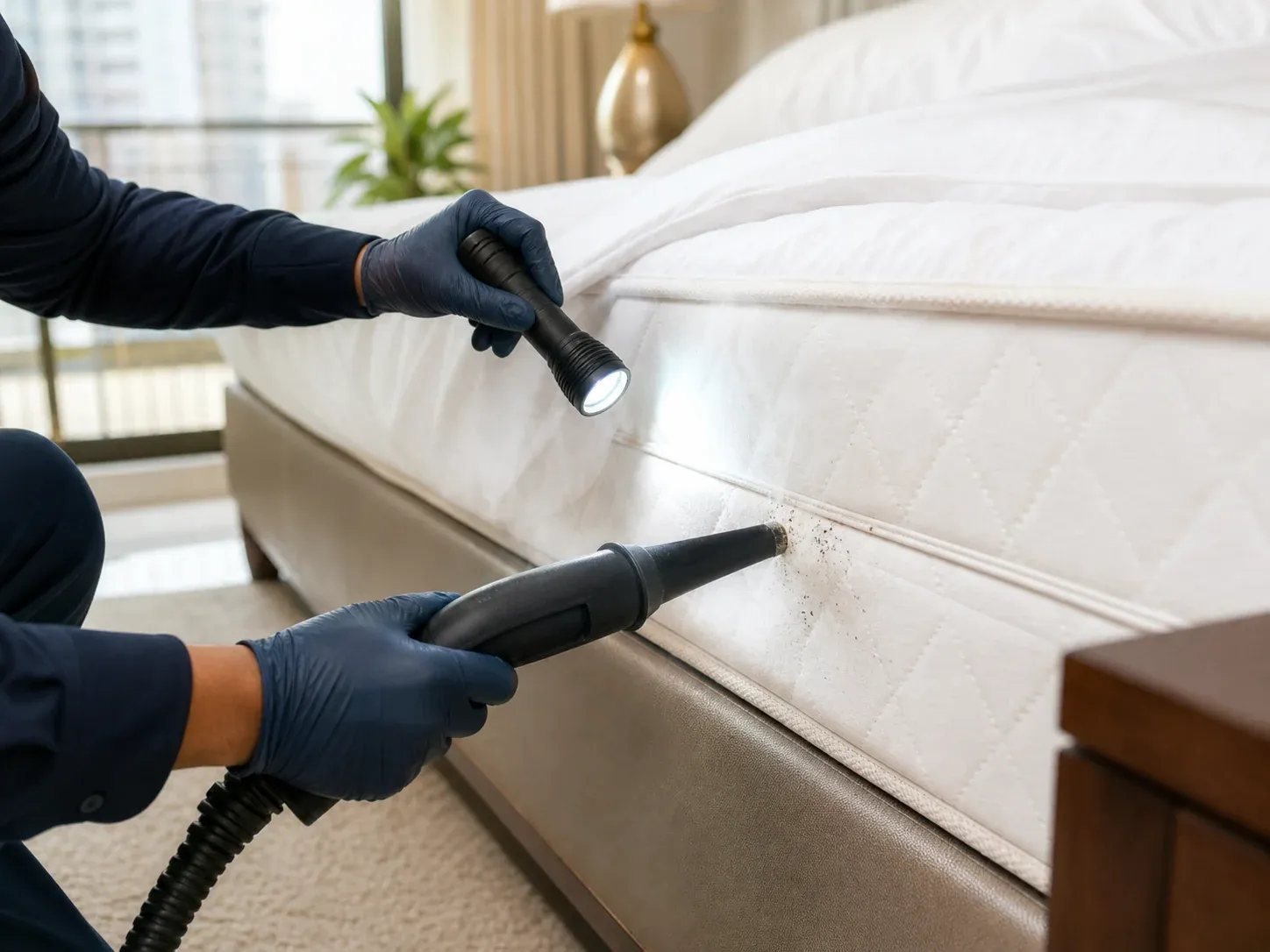
- Heat steam is directed at the stitching seams, the sofas, the cracks, and inside the bed frame. The very high heat kills bed bugs and eggs on contact, and this is what solves the egg problem that spray cannot handle. Its advantage is that it leaves no chemical on the surfaces you touch, like the mattress.
- Residual spray is applied in the cracks, behind the furniture, and along the insect’s movement paths. This insecticide stays effective for weeks, so any insect that hatches later or had hidden deep and did not come out gets exposed to it as it moves and dies. This covers the period after the visit and catches any survivors.
Combining the two closes the loop: steam kills what is present and the eggs immediately, and spray catches any remnants or later hatchings.
4. Treating Cracks and Furnishings in Detail
The technician focuses on the details that usually get neglected: the screw holes in the bed, behind the nightstand, under the carpet edges, behind peeling wallpaper, picture frames, and even the light switches if there is any suspicion. Each of these cracks is a potential nest.
5. The Follow-Up Visit
This step is not a luxury, it is a necessity, because of the egg problem and resistance. We return after a set period (usually two to three weeks) to wipe out any eggs that hatched after the first visit and to confirm there is no new activity. A company that comes once, tells you “it is treated,” and leaves with no follow-up is not taking the bed bug problem seriously.
The Difference Between Heat Steam and Chemical Spray
A lot of people ask: do I need steam or spray? The honest answer is you need both, because each one does something the other cannot. Let us make the difference clear:
Heat steam:
- Kills bed bugs and eggs instantly on contact through heat.
- Leaves no chemical trace on surfaces, so it suits the mattress and anything your body touches.
- Its effect is instant but has no lasting action once the area cools.
- Needs direct reach to the insect, so anything hidden away from the steam survives.
Residual spray:
- Stays effective for weeks, so it catches insects that appear later or move along their paths.
- Covers spaces and cracks that steam cannot fully reach.
- Has limited effect on the eggs, which is exactly what the steam completes.
- Needs correct placement in the right spots to stay both effective and safe at the same time.
So instead of thinking of them as alternatives, think of them as a team. Steam lands an instant knockout blow on what is present and on the eggs, and spray guards the place for weeks afterward. That is the difference between a treatment that ends the problem and one that merely postpones it.
How Long Does It Take and How Many Visits?
The right expectations put everyone at ease. No reputable company will tell you “I will finish in a day and you will never see them again” and be telling you anything accurate, because the nature of bed bugs itself demands follow-up.
- The first visit: This usually takes from two to four hours depending on the size of the place and the number of infested rooms. Afterward you notice a large and rapid drop in the bites.
- The follow-up period: We schedule a second visit after two to three weeks. The main reason is the eggs that may have hatched after the first visit, so we wipe them out before they grow and lay again.
- The number of visits: A minor infestation usually needs one visit and a follow-up. A widespread or old infestation may need a third visit. This is determined after the inspection and stated clearly to you from the start.
As for the bites disappearing, most people notice improvement within the first days after the first visit, and complete disappearance is confirmed as the follow-up is completed. Patience with the follow-up plan is what separates “it eased and came back” from “it is gone for good.”
What Do Bed Bug Control Prices Depend On?
The price question is natural and fair, but let me be straight with you: anyone who gives you a final, firm number over the phone before seeing the place either does not understand the nature of bed bugs or is giving you a fake figure that will change later. The price of bed bug control is set after the inspection, and it depends on clear factors:
- The size of the infestation: A minor infestation in one bed is different from a widespread one across several rooms. The wider the spread, the greater the effort, materials, and time.
- The area and number of infested rooms: A small apartment partly infested is different from a villa or large apartment where the bugs have reached most of its rooms.
- The number of visits required: One visit and a follow-up is different from a three-visit plan for an old, stubborn infestation.
- The type of treatment and furnishings: The presence of sofas, curtains, and heavy furnishings that need steam raises the time and effort.
- The condition of the place and its preparation: A well-prepared place makes the work easier, while a place full of clutter takes greater effort to reach the cracks.
This is why we do the inspection first, see the situation with our own eyes, and then present you with a clear, written price with no surprises. That transparency is your right, and it is part of choosing correctly.
How Do You Choose a Good Bed Bug Control Company?
The market has reputable companies and it has people who take money, do a surface spray, and leave. To protect your money and your time, look for these criteria:
A Real Guarantee
A company confident in its work gives you a guarantee on the treatment, meaning that if activity appears during the guarantee period it comes back and treats it at no extra cost. A guarantee is what turns talk into a real commitment. Ask about it before you sign.
Safe, Registered Materials
Ask about the materials that will be used and whether they are registered and approved for use in residential spaces. This matters especially if you have children, elderly people, or anyone with an allergy in the home. A professional company knows how to answer and gives you clear safety instructions (for example, how long before you return to the room).
Experience and Specialization in Bed Bugs Specifically
Bed bugs are a special case. Ask: do you have experience with bed bugs in particular? Do you use heat steam or just spray? Do you do a follow-up? The answers separate a company that understands this enemy from one that treats it like any ordinary insect.
Price Transparency and Inspection
As we said, an inspection before the price is a mark of professionalism. A clear, written price with no hidden items reassures you that you will not be caught off guard.
Follow-Up as Part of the Service
Any bed bug control offer without a follow-up visit is an incomplete offer by its very nature. Make sure the follow-up is included and spelled out in the agreement.
If you would like to see the rest of what we offer in solutions for different insects, you can browse all our pest control services and learn how we handle each type with a method tailored to it.
Prevention Tips After Treatment
After you get rid of the bed bugs, a few simple habits greatly reduce the chance of their return or of a new infestation getting in:
- Keep the encasement mattress and pillow covers on after treatment. They remain an excellent line of defense and make it easy to catch any insect early.
- Always inspect after travel. The moment you return from a trip, it is best to wash the suitcase clothing at high heat right away and inspect the suitcase itself before you store it.
- Avoid used furniture without inspection. If you must, sanitize and inspect it carefully outside the home first.
- Seal the cracks. Closing cracks in the walls and around the window frames and switches reduces hiding spots and the entry points from neighbors.
- Reduce clutter around the bed so your view stays clear and you catch any beginning quickly.
- Inspect periodically. Every so often, especially if you traveled or had guests sleeping over, take a look at the mattress stitching seam. Early discovery saves you a great deal.
- Act early. If you suspect any sign, deal with it immediately. A small infestation at its start is far easier and cheaper than one that has grown and spread.
Bed bugs share the same draw as many other insects that love the warm Egyptian home, and if you want to know how to handle other unwelcome visitors, read our article on getting rid of cockroaches as well.
Frequently Asked Questions About Bed Bugs
Do bed bugs transmit diseases?
So far, bed bugs are not known to transmit diseases to humans the way mosquitoes do, for instance. But that does not mean they are harmless. The bites cause intense itching and allergic reactions, and repeated scratching can lead to secondary skin infections. More importantly, there is the psychological toll: the insomnia, anxiety, and lost sleep genuinely affect your health and your life. So they are disturbing and harmful in an indirect way, even if they do not carry disease.
Can I just live with bed bugs until they disappear on their own?
No, and that idea comes at a high cost. Bed bugs do not disappear on their own. On the contrary, they multiply quickly and spread from room to room. Every day of delay means greater numbers, wider spread, and a harder, more expensive treatment later. Early action is always cheaper and faster.
If I throw out the mattress, will the problem be solved?
Throwing out the mattress alone rarely solves the problem, because the bed bugs are also present in the bed frame, the nightstand, the cracks, and the wall. And if you throw out the mattress without treatment, you can spread the bugs while carrying it out and contaminate other rooms. Comprehensive treatment is better, and if the mattress is going to be thrown out we recommend treating and wrapping it first before it is moved outside.
Is heat steam safe for furnishings?
Professional steam is used safely on many materials when done the right way by a skilled technician who controls the heat and the distance. The technician takes the fabric type into account and avoids anything sensitive to excess heat. This is one of the reasons steam should be handled by a professional, not by some random device.
I was treated before and they came back, why?
The most common reasons: treatment with a single method only (spray without steam), so the eggs survived and hatched; no follow-up visit; the infestation was wider than what was treated; or re-entry from an outside source like travel or neighbors. The dual method along with follow-up is what closes these doors.
How much do I need to prepare before the company’s visit?
The ideal preparation: wash the bedding and the clothing near the bed at high heat, clear the clutter around the bed, leave room to reach the bed frame and the nightstand, and move food, dishes, and pets away during treatment. The better you prepare, the stronger and faster the result.
Conclusion
Bed bugs are not a cleanliness problem and they are no fault of yours. They are an insect that is clever at hiding and stubborn at breeding, and what makes them so harmful is that they rob you of your sleep and your peace. Understanding how they live (the egg that shields itself, the deep hiding, the resistance, and the endurance without food) makes it clear why surface fixes fail and why this calls for a serious method.
Home remedies like high-heat laundering, steam, vacuuming, and encasement covers have value as supporting measures, but on their own they rarely end the problem. Real elimination comes from professional treatment that combines heat steam (which kills the insect and the eggs instantly) with residual spray (which guards the place for weeks), together with a follow-up visit that closes the egg loop.
And when it comes time to choose, look for the company that inspects you first, gives you a clear written price, uses safe registered materials, has experience with bed bugs in particular, and commits to a guarantee and a follow-up. That is what turns the treatment from a mere “spray” into a solution you sleep soundly after, knowing your bed belongs to you alone. If you have reached the point where you want to end this the right way and for good, the inspection is the first correct step, and we are ready to get you to the rest you deserve.